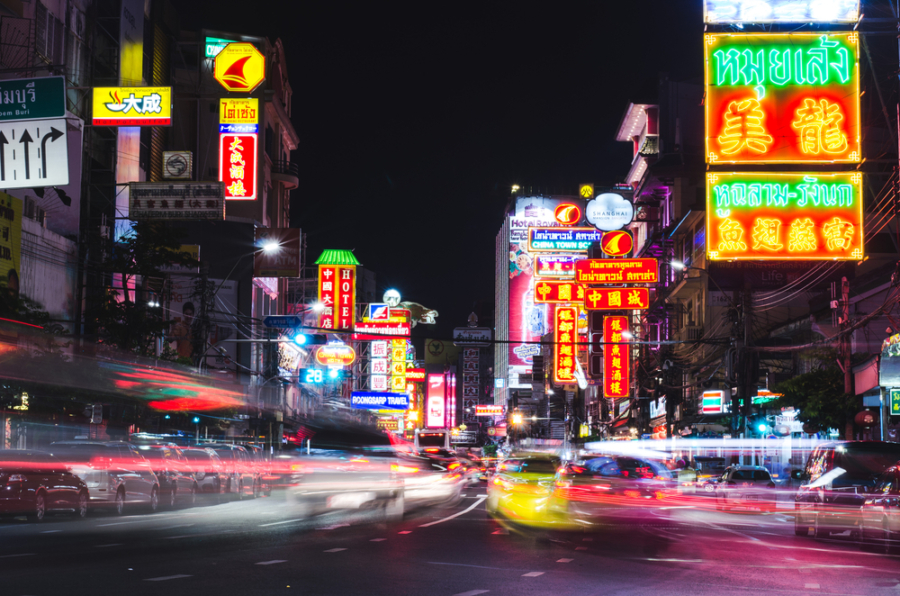
Lek was 21 when she arrived in Bangkok. Fresh from a music degree at her local university, she was ready to leave her middle-class life in rural Phetchaburi behind. Her dream was to make a successful career in music. And one of the world’s great entertainment hubs was just a few hours’ bus ride away. Packing up her things, taking that bus ride, starting a new life in Bangkok – Lek made the leap without hesitation. Each year, thousands of young Thais make the same journey, trading provincial familiarity for the promise, and uncertainty, of the mega-city.
“Moving to Bangkok, it was a lot at first,” Lek recalls. “But I found work quickly, providing private music tutoring. Then I got my first singing gig through a friend.” Gradually, she built connections. Bars and event organisers began to hire her regularly. She performed her own songs and picked up occasional songwriting jobs for others.
Soon, she was on stage seven nights a week, sometimes at multiple venues in a single evening. Bangkok was expensive, and like many Thais she felt obliged to send money home each month. “I just had to get myself out there and make sure people knew who I was,” she says. The pace was relentless. “Too much, perhaps. I wasn’t finding any time to be creative.”
A remedy for exhaustion
Lek mentioned her exhaustion to a friend in the industry, who suggested something she said had helped her cope: crystal methamphetamine, known locally as ice. Lek hesitated. She had tried cannabis before and hadn’t liked it. But this felt different.
“Immediately, I felt focused,” she says. “I was plugged into the harmony of the music and everything just flowed.”
At first, her use was sporadic. Ice was a tool: something to sharpen concentration, to unlock creativity, or to power through long nights on stage.
Lek’s experience is not uncommon. Methamphetamine is the most commonly consumed drug in Thailand. Its use is rising too, especially following the start of the most recent conflict in Myanmar where production has increased. In 2024, 1.5 million Thais were thought to have taken the drug. The majority of methamphetamine is mixed with caffeine and sold in pill form as yaba, although use of the more expensive ice is also on the rise in Thailand.
Methamphetamine, particularly in yaba form, often serves a functional purpose and is popular among working-class Thais, both rural and urban. It allows workers to exert themselves more intensively and for longer: popular, for example, with agricultural workers who often receive a piece rate, or truck drivers paid according to the number of journeys they complete.
Although there is a certain degree of social acceptance towards methamphetamine use in rural Thailand, this acceptance is within very prescribed boundaries: it must be used occasionally and as a tool to enhance income; use outside of these contexts, and especially in cases where a person falls into addiction, may mean ostracisation from the community.
According to Pavanpart Palamart of the activist group The People’s Fight Against Discrimination, which advocates for the rights of those who use drugs, “if you use drugs in the countryside everyone knows, and they might talk badly about you.” However, relocating to a big city like Bangkok opens up new possibilities to use drugs, away from familial judgement: “in an urban area, no one knows you. It’s very easy to hide what you’ve been doing”.
Urban isolation
Life in the capital brings emotional strain as well as opportunity. According to a 2025 study, 41% or urban Thais reported feeling isolated. Lek, who lives alone, says she often misses her family in Phetchaburi. “I started using it to regulate my emotions,” she explains. “If I’m feeling sad, I know it will take me out of that suffering.”
For many rural-urban migrants, separation from family and familiar networks can be disorienting. Building new friendships in a vast city is not always easy. Urban life often fragments social ties. “When you live in an urban area, you live your own life,” Pavanpart tells Talking Drugs. “People that we support, they tell us that finding friends and community can be hard. Using ice can help people overcome social barriers and make connections.”
For a time, ice seemed to help Lek build both confidence and connections. Her career was gaining momentum. Then the pandemic hit. When the country started opening up again, restarting in Bangkok’s music scene was far from straightforward. Many venues had closed permanently, and the industry was unstable. “It’s so easy to be forgotten,” she says. “It felt like I had to start from the beginning.” Her use escalated. What had once been occasional became routine. “If I didn’t use, I had no motivation to go out and look for work, not even to clean my room. But I had to,” she explains.
And in the post-pandemic period, living costs in Bangkok rose sharply. Rent and food became harder to cover. Lek accepted whatever work she could find and often had to travel for hours across the city to pick up odd jobs for modest pay. Ice, now a daily habit, helped her sustain her pace of life. “It helped take away some of my fears and anxieties,” she says.
Although she comes from a lower middle-class background, Lek’s circumstances mirror those of many migrants working in more traditionally working-class occupations. High living costs, modest wages, family expectations and a limited social safety net leave little margin for failure. Thus, for many of those trying to make it in the city, other concerns – potential legal risks, for example – took a back seat.
When it comes to methamphetamine, the law is unforgiving. In 2024, the Thai government passed a directive stipulating that any one person found in possession of a single yaba pill will be required to attend mandatory rehab; those that refuse may risk criminal prosecution. For Yet there’s an irony at play here. As researcher Patrick Meehan has observed, “much of Thailand’s economy has been built on endless labor”, and that endless labour is so often made possible by methamphetamine. Stimulant use and economic development seem inherently bound together.
When I ask Lek whether she regrets using ice, she pauses. “It hasn’t all been good. Actually, I’ve started to notice the ways it’s been impacting my health – for example, I’ve noticed that my memory’s not as good now. But if I hadn’t used it, I don’t think I would have worked this hard,” she says. “Bangkok life is hard. I’m not a millionaire. But at least I didn’t have to go home and tell my parents I failed.” In a city where endurance is often mistaken for success, and where competition is strong, being ‘on speed’ is often less a choice and more a condition of survival.