

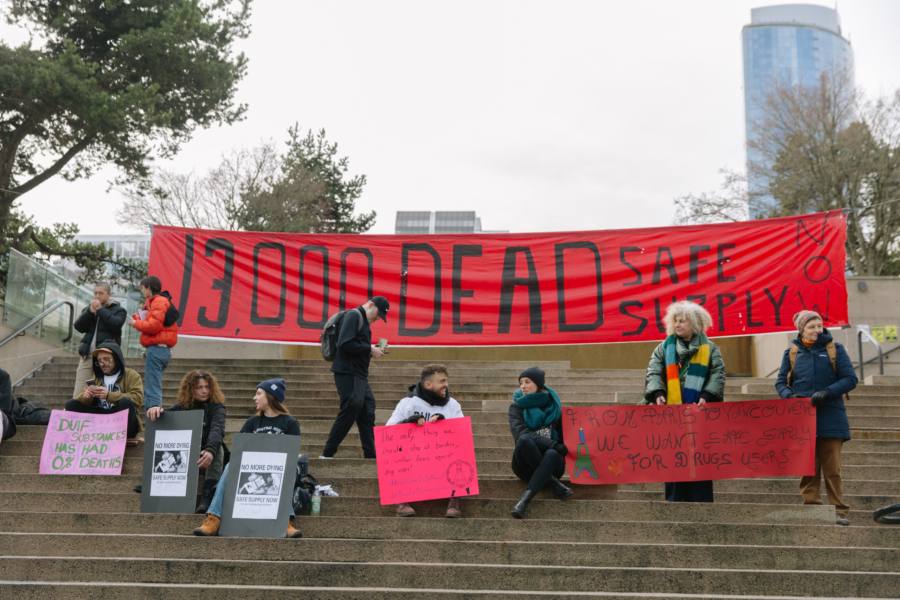
On 24 July, final arguments concluded the Drug User Liberation Front‘s (DULF) trial challenging Canada’s constitution. If they win, this would mean proving that laws preventing the formation of their “compassion club” to distribute safe drug supply are a barrier to protecting people who use drugs. Failure means being sentenced for trafficking charges and the court standing behind Canada’s current drug prohibition laws.
Last November, DULF co-founders Jeremy Kalicum and Eris Nyx were found guilty of possession for the purpose of trafficking after buying heroin, methamphetamine, and cocaine on the dark web, testing it to ensure its purity, and then selling it at cost. A primary aim of the initiative was to reduce drug overdose deaths amid an escalating opioid crisis in Vancouver.
DULF’s legal team, composed of Tim and Stephanie Dickinson and Kaelan Unrau, spent weeks this year arguing there was “no practical path” for DULF to implement safe supply legally. They argued DULF were distributing drugs to save lives and that people who use drugs are a vulnerable community deserving protection under Section 7 of the Canadian Charter of Rights and Freedoms, part of the constitution.
“Everyone has a right to life, liberty, and security of the person, except in accordance with the principles of fundamental justice,” said Margot Young, Constitutional Law Professor at the University of British Columbia, paraphrasing Section 7. “That last part is the tricky part, because it basically says that if the government is following the principles of fundamental justice, then they can infringe your life or liberty or security of the person.”
This means the Charter protects people, but only up to a point. If the judge decides DULF broke existing laws that are just, the Charter doesn’t protect them and they will face consequences.
“Part of the rendering of these drugs illegal, or possession of them, or trafficking of them, is to protect general public health and safety. But in fact, if what you’re doing is making people more unsafe by not allowing these kinds of compassion clubs, because they’re rendered illegal under the statute, then what you’re doing is arbitrary,” said Young.
Crown prosecutor, Oren Bick, argued that the legal avenues for DULF to obtain authorization to distribute heroin, cocaine, and methamphetamine had not been exhausted. Bick pointed out that DULF could have bought safe supply from pharmaceutical companies approved under Canada’s Food and Drugs Act. It’s true that pharmaceutical grade heroin technically exists, but DULF’s defence said getting approval under the Food and Drugs Act can take years and millions of dollars.
DULF had looked into this path, but operating on a shoestring budget, they instead proposed a plan for Health Canada to buy the cocaine, heroin, and methamphetamine on the dark web. DULF had initially applied for Health Canada Approval. They waited 11 months, only to be told their dark web model wouldn’t work. They also emphasized that witnessing deaths on the Downtown Eastside added urgency. During the trial, Nyx recounted the feelings of panic felt leaving her apartment everyday with Naloxone, knowing she would have to use it that day.
Bick implied DULF still could have found a way through the bureaucracy. But the difficulty, or as the defence suggests the impossibility, of navigating Canada’s legal system to access and distribute safe supply is the question at the very core of DULF’s case.
People were dying, DULF had a research backed solution, and when attempts to jump through existing Health Canada hoops failed, DULF took action, getting what legal authorizations they could. They bought the drugs on the dark web, tested them, and opened up shop on the Downtown Eastside.
The resulting compassion club earned them international media attention, a subsequent police raid, and now years of legal battles.
In the event the case is successful, Young says the court could go several routes. An unlikely path is DULF getting an individual exemption, while the law is held as constitutional and enforced for everyone else. Young thinks a suspended declaration would be more likely, meaning the judge would take time to review the unconstitutional law, taking submissions, and drawing DULF’s legal process out further, but said, “I think it’s probably unlikely that there’ll be a finding of unconstitutionality.”
“There have been other challenges to drugs being illegal that have been based on the fact that without some kind of legality and ability to use safely, you have tremendous devastation,” said Young. She notes that while Insite, Vancouver’s first safe injection site, did win a Supreme Court decision in 2011, there is still tremendous pushpack on safe injection sites and safe supply.
“We’re in a long-term flux right now about how the government is actually going to deal with the deep harm of toxic drugs on our street and the problems of individuals who have no option given their health concerns to continue to use toxic drugs. And the lack of the kind of guardrails we would expect a society to have, a caring society to have, around this crisis that the government seems unable to do, given the sort of set of preconceived ideas about hard drug use.”
When it comes to what will happen to DULF, Young says we will have to wait and see.
“At the level of figuring out what the punishment is, the court will take account of the fact that this is not a backstreet trafficker, but a compassion club. And you already saw in that judge’s decision some indication of what these people were doing being noble and helpful for disadvantaged individuals.”
For Dr. Carl Hart, Columbia University professor and neuroscientist, what DULF is standing up for is something fundamental.
“I think about just people having bodily autonomy, the right to do with their body what they choose, all of these democratic nations claim to or they profess to deliver that to their population,” Hart told TalkingDrugs. “If you do that, then you also have a responsibility to make sure that the market is not contaminated with substances that potentially kill people.”
Dr. Hart was present at last November’s sentencing and spoke at a legal fundraiser in support of their work.
“What I hope is that more people see what these young people were trying to do and what they were trying to accomplish. And then other people also stand up and try to do their best to do reasonable interventions to make sure people are safe,” said Hart. “I’m shocked that it becomes controversial to do the right thing.”
The results of DULF’s trial will be announced in January.

