Back in January, a video of a group of armed Black men dressed in bomber jackets and berets at an anti-ICE protest in Philadelphia went viral.
“Won’t no ICE agent ever run up on me!” said Chairman Paul Birdsong. “I guarantee you they won’t… I’ll put a hole in their chest the size of a window!”
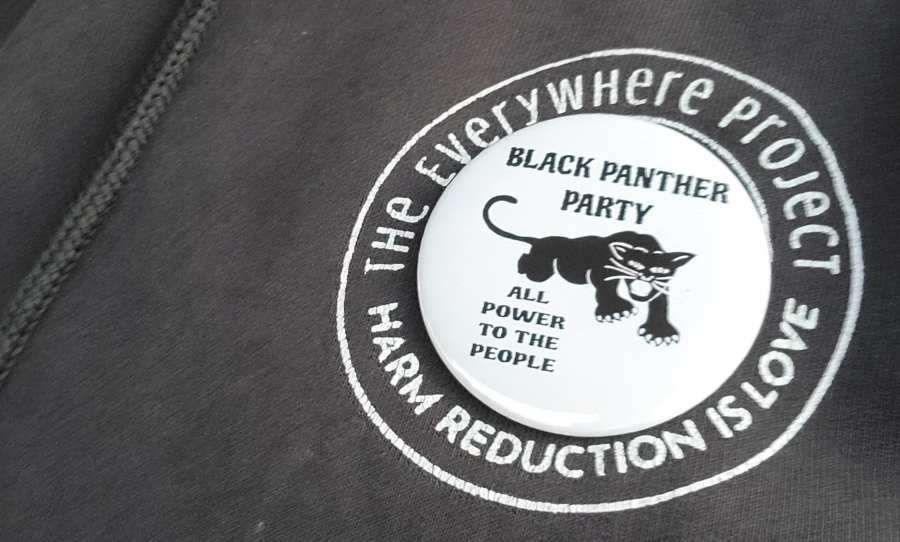
The group, known as the Black Lions, take ideological inspiration from the original Black Panthers Party, a radical organisation for African-American empowerment in the 1960s and 70s.
During the Civil Rights Movement, the original Panthers became infamous for mounting armed citizens’ patrols through the streets of Oakland and other cities, keeping watch for police brutality. While the Republicans are roundly known as the party of gun owners in America, it was none other than Ronald Reagan who approved California’s first gun restrictions in 1967, after the Panthers showed up to a protest brandishing shotguns.
Aside from wielding weapons, the Panthers also ran community support programmes like free breakfast initiatives that fed thousands of hungry kids before school. Now, the Black Lions are leaning on that legacy, handing out food to those that need it on the streets of Philadelphia.
But in addition to protecting their community against police brutality and ICE raids, the Black Lions have also formed an unexpected alliance with another group: harm reduction activists.
Thomas Frey is the operations director at The Everywhere Project, a harm reduction organisation based in Philadelphia, where drug deaths have fallen to their lowest point in a decade, despite the fact that Trump and city administrations have slashed funding for vital harm reduction services. The Everywhere Project has an outreach site in Kensington, where they provide meals and medical assistance to 4-500 people each Saturday.
The working-class neighbourhood of Kensington is possibly the most notorious open-air narcotics bazaar nationwide. The 1.9-mile stretch of narrow streets along Kensington Avenue was home to at least 80 drug operations in 2020. Some blocks sold USD $400,000 worth of dope in a week. Intelligence-led police operations have brought down whole drug rings, only for another gang to set up shop on the very same street corner the very next day.
“That’s where most of the dealers are and that’s where everybody’s going to get their cheap drugs. We’re the gateway to the United States. Stuff’s coming in here on the East Coast first, then it kind of spreads West over there,” said Frey.
“We know what’s in the drug supply months before the rest of the country does.”
Harsh cutbacks
Now Frey and his team are feeling the effect of cutbacks. On a national level, the Trump administration has axed budgets for drug treatment, harm reduction and scientific research, with Medicaid – responsible for nearly 90% of addiction treatment in the United States – losing a trillion dollars in funding through his Big Beautiful Bill signed last year, while local initiatives have had their grants terminated.
But it’s not only the federal government. Public opinion towards people who use drugs has become more polarised as well.
“We have a whole subgroup of people with the theory of: ‘Just let them die. They’re a waste of human life. Why save them?’ And we have angry neighbours that have a large drug scene going on in their backyards, and they feel like we’re enabling them,” Frey shared.
Under pressure from voters blaming untreated addiction for social decay, officials in cities including Philadelphia are also defunding harm reduction. For example, Frey said, the organisation was due to be reimbursed USD $100,000 from the settlement funds paid out by Big Pharma for their roles in the opioid crisis. But the last payment of USD $25,000 was withheld, after The Everywhere Project had already spent it.
“For any harm reduction group to have $25,000 held back on them is a significant portion of their funds,” Frey reflected. “It almost feels like they’re trying to eliminate us through attrition.”
Last year, Philadelphia imposed limits on when and where outreach work can be conducted, arguing that homeless people congregating and using drugs are a public nuisance. This, Frey said, has invited more police harassment.
“The regular police in Philadelphia are working intimidation tactics with the homeless population and the harm reduction groups… The increased police presence, intimidation, and the threat of ICE is scaring people from seeking the exact things we’re trying to give them to get another day alive. People are afraid that if the cops pick them up and they have a warrant, then ICE is coming to get them next; whether they’re immigrants or not.”

Declining deaths
So why are deaths still declining while harm reduction is defunded?
No-one knows for sure, but there are several theories. Firstly, naloxone is now available everywhere, even in certain vending machines. Another possibility is that tightened chemical manufacturing restrictions in China since 2023 have made fentanyl production trickier. This fits with Tom’s observations on the streets of Philadelphia.
“One of the things we’re finding is what we consider opioids, or the fentanyl, have very little fentanyl left in them,” Tom observed.
“Heroin 10 years ago was $10 a bag. Now you can get what’s considered fentanyl, but is really tranq and medetomidine for $3 a bag. So it’s very easy for somebody to get a fix and be nodding out for $3, which is not that hard to get anywhere.”
In the 2010s, Philadelphia was ground zero for ‘tranq dope’, a cocktail of fentanyl with xylazine that provides a longer-lasting high than fentanyl alone. Its side-effects, however, were ghastly wounds in injection sites.
New mixes
While tranq dope is dangerous, it’s less (immediately) deadly than an opioid overdose. But the diluted dope has its own complications.
“We had fentanyl, and then they were cutting the fentanyl with the tranq. And then now they started eliminating fentanyl, increasing the tranq, and [now] there’s medetomidine in there,” Tom continued.
“When you’re withdrawing from medetomidine, or even if you’re overdosing on it, the [naloxone] doesn’t do anything for it because it’s not a true opioid. And the medetomidine is causing such horrible withdrawal symptoms that the doctors are having a hard time getting control of it… People are actually really suffering, and we’re having people stroke out from withdrawal. Whereas heroin and fentanyl, as horrible as it was to withdraw from, it wasn’t going to kill you.”
These new drug combinations have left even medical professionals scrambling to keep up.
“We’re failing at re-educating people on how to treat the new supply of drugs. It’s just very difficult. The paramedics don’t fully understand when they’re treating people,” Frey explained.
View this post on Instagram
Black Lions and harm reduction
So how do gun-toting Black Lions fit into all this?
By Tom’s account, after the anti-ICE protest at City Hall, the local government stopped supporting the Lions’ meal drives. The Everywhere Project stepped in and provided the Lions with their spare stocks. It wasn’t long before the Lions returned the favour.
“We talked with them about our struggles with the local police and authorities harassing us at a meal site that we’ve been at for five years,” Tom recalled.
“The police were harassing us nonstop because the city put restrictions on harm reduction groups and food groups feeding the unhoused… And the harassment of our guests and our volunteers at the meal site has escalated to such a point that I actually said to Chairman Paul, ‘could you do me a favour and just come out and give a show of solidarity with us?’”
So they did. The Lions showed up at the meal site in Kensington, carrying their usual high-calibre hardware. A squad car pulled up and an officer rolled down the window.
“Hey, what’s going on over here?” the police officer asked.
Chairman Paul walked over.
“Your assistance isn’t needed here, we got it covered, thank you,” he told the officer. The police got the message and drove away.
“The police presence at our meal sites decreased by 90% after that,” Tom said.
“I often get in screaming matches with the cops about violating my personal rights while I’m out there. We haven’t had that issue in a month-and-a-half now. Maybe once or twice the cops will roll by, see what’s going on and be on their way.”
All-in-all, the overdose crisis is steadily improving. But Sheila Vakharia, Deputy Director of Academic Engagement at the Drug Policy Alliance, warns against complacency.
“We are not in the clear – we have simply returned to the number of deaths we saw annually prior to COVID, when there was a significant spike in deaths,” she cautioned. “They have not declined equally in all states and we know that Native and Black populations still have unacceptably high rates of overdoses, even after rates have declined.”
It is still too early to assess what impact federal cutbacks are having, Vakharia added, not to mention any more budget-busting antics Trump may engage in during his tenure.
“There is absolutely a risk that we may see the downward trend either plateau or uptick again.”