Known scientifically as “Mitragyna speciosa Korth”, the kratom plant grows wild in Kalimantan, Indonesia. Native to Southeast Asia, this psychoactive plant has been used as a both stimulant and a sedative in traditional medicine for generations, with effects such as mood elevation and pain relief.
However, for the past decade, kratom has been at the centre of intense controversy, with ongoing debates over proposals to outlaw it. This regulatory ambivalence began when the Indonesian government prohibited kratom for medical use in 2016, followed by the proposal to classify it as a Schedule I narcotic in 2019. Then, in a dramatic policy reversal, kratom was recognised as a legal export commodity in 2024.
Such shifting policies reflect a narrow way of governing kratom, one that views the plant only through two lenses: illegality on the one hand and economic value on the other. Missing from this debate entirely are the experiences of Indigenous communities who have long lived with and relied on kratom. Research conducted by the Indonesian legal aid group LBH Masyarakat (LBHM) among the Dayak Kalis Indigenous Community in Kapuas Hulu, West Kalimantan shows that kratom is far more than a commodity. It is part of local knowledge, cultural practices, and everyday life.
“Kratom is our lifeblood,” said an Indigenous leader of Dayak Kalis, underscoring the deep relationship between the community and kratom. Yet the dominant war on drugs paradigm continues to frame kratom primarily as a psychoactive threat. As a result, policy debates often revolve around prohibition, while the recent recognition of kratom as an export commodity largely responds to global demand, particularly from the United States, which remains its largest importer. In 2023, Indonesia exported around 4,703 tons of kratom to the US, valued at over USD 9 million. In 2025, the Ministry of Trade even facilitated its first official export shipment of 351 tons to international markets.
This emerging recognition of kratom as an export commodity tends to prioritise economic potential over its broader significance, often overlooking its role in sustaining local livelihood and cultural practices.
Kratom for health
For the Dayak Kalis Indigenous Community, kratom has long been used as a traditional remedy. Community members commonly apply crushed kratom leaves directly to wounds or skin conditions such as eczema. The leaves are believed to help stop bleeding and accelerate the healing process, making them a practical treatment for injuries sustained during daily work.
Kratom is also consumed as an herbal drink. Fresh leaves are typically boiled in water and taken in small amounts to relieve pain, reduce headaches, and improve sleep quality. These practices reflect the community’s long-standing reliance on plant-based remedies as part of their everyday approach to maintaining health.
Beyond these local practices, empirical experiences with kratom are also reflected in findings from studies conducted in other contexts. A study in the US involving 2,798 kratom users found that 91% reported using it to relieve physical pain, while others used it for anxiety and depression. Notably, 41% reported using kratom to manage opioid withdrawal symptoms, with 35% of those respondents remaining abstinent from opioids or heroin for at least one year.
At the same time, its effects remain debated, particularly regarding its potential for dependency and other side effects. These differing perspectives highlight the need to understand kratom not simply as a threat, but as a substance with both risks and benefits, shaped by the contexts in which it is used, including by communities who have long relied on it as part of their everyday healthcare practices.
Kratom for livelihood
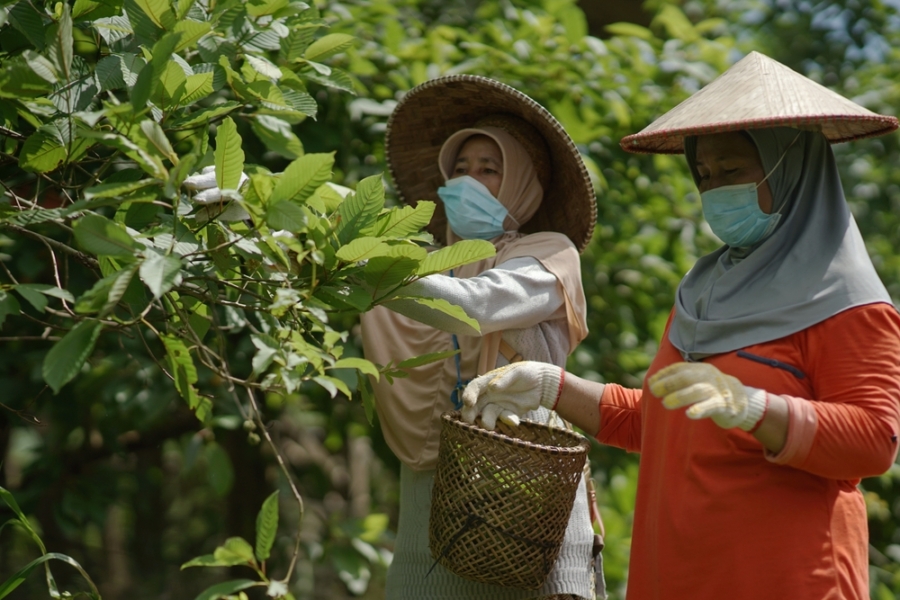
Beyond its medicinal use, kratom has also become an important source of income for many households in the community. Farmers harvest the leaves and sell them through local traders, turning what was once a wild plant into a steady source of cash. Because kratom grows easily and can be harvested regularly, it often provides a more dependable income than other crops. In Kalis Raya Village, for example, around 80% of residents rely on kratom cultivation and trade as their primary source of income.
Women are frequently involved in picking and processing the leaves, making kratom farming an activity that engages many members of the household. The income earned from kratom sales is commonly used to meet daily needs, from buying food to supporting children’s education. In this way, kratom quietly sustains the local economy and helps families maintain their livelihoods.
However, as kratom is increasingly treated as an export commodity, there is a growing risk that this economic lifeline may be reshaped in ways that disadvantage Indigenous communities. Expanding market demand and regulatory frameworks could shift control over production and distribution toward larger commercial actors, potentially marginalising small-scale farmers. Without safeguards, the communities that have long depended on kratom may be excluded from the very value chains they helped sustain.
Kratom for ecology
Kratom is also deeply connected to the community environment. It grows naturally along riverbanks and wetlands, thriving even in acidic or waterlogged soils. Its dense roots help hold the soil together, reducing erosion and lowering the risk of landslides in flood-prone areas.
Kratom grows easily without fertilisers or intensive care, making it ideal for reforesting degraded lands and restoring natural habitats. Local authorities in West Kalimantan have recognised this, including kratom in programs for non-timber forest products. In this way, the plant embodies the principles of a bioeconomy, supporting both community activities and ecological sustainability.
The plant’s benefits go further still. Wood from older kratom trees can be used to make furniture like cabinets or tables, allowing families to meet their material needs without cutting natural forests. For the Dayak Kalis, this represents a way of living in harmony with the land, where economic activity and environmental care go hand in hand.
Rethinking kratom policy
Taken together, kratom is far more than just a commodity or a psychoactive plant. For the Dayak Kalis Indigenous Community, it supports health, provides livelihoods, and helps maintain the environment. Yet unclear laws and policies leave farmers vulnerable, caught between debates over prohibition and export, while the communities that depend on it are often overlooked.
A more inclusive approach is needed. Kratom governance should put Indigenous communities at the center – building farmers’ skills, improving post-harvest practices, and ensuring fair access to markets. Policies on its medicinal use should balance drug-control concerns with scientific research and the generations of knowledge held by the community.
What sets kratom apart is its non-extractive nature. From roots to leaves, it provides medicine, income, and ecological benefits. Recognising it as part of Indonesia’s non-timber forest resources and honouring its connection to Indigenous communities could create a governance model that is both economically fair and environmentally sustainable.