For decades, the global “war on drugs” has been sold as what’s best for public health: by harshly criminalising drug use, people would be scared into abstinence, creating a drug-free and healthier society.
But the reality cannot be farther from the truth.
In the world of HIV prevention, punitive drug laws have repeatedly been shown to work against its own objectives. Criminalising people who inject drugs has pushed people away from health services, increased stigma and social marginalisation of those using drugs, and driven riskier drug using behaviours such as needle sharing. People who inject drugs remain at a dramatically higher risk of HIV.
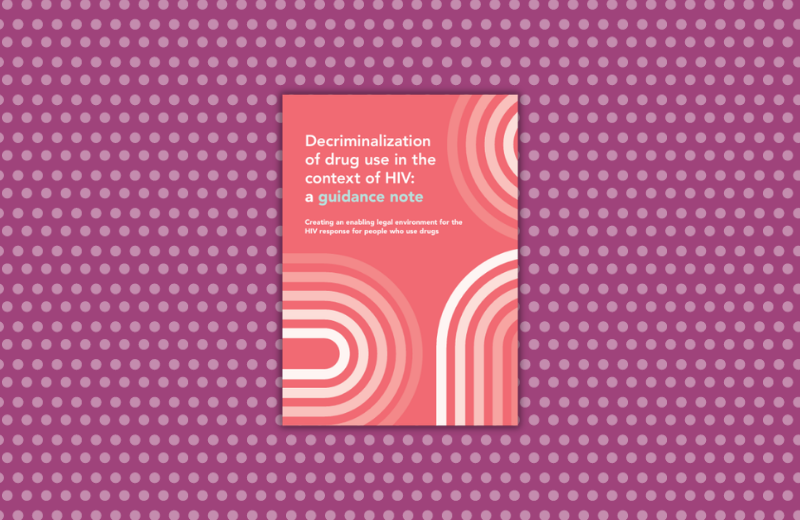
As more and more countries around the world grapple with the deadly consequences of drug criminalisation, a new UNAIDS guidance document, titled “Decriminalisation of drug use in the context of HIV: Creating an enabling legal environment for the HIV response for people who use drugs” sets out to answer a question that is increasingly relevant in global drug policy: if a country decides to decriminalise drug use, what should that system look like?
Rather than arguing the philosophical case for reform, the report functions more like a practical manual outlining all the global evidence on the benefits of decriminalisation of public health systems that are focused on eliminating HIV in a health-oriented, evidence-based, and rights-based way.
As Julie Hannah, Director of the International Centre on Human Rights and Drug Policy and one of the report’s contributors, told TalkingDrugs:
“By drawing on decades of global experience with decriminalisation, [the report] helps operationalise the International Guidelines on Human Rights and Drug Policy, translating international human rights standards into practical guidance for governments seeking reforms that are meaningful for communities.”
Drug policy = HIV policy
The starting point of the report is simple: drug policy is HIV policy.
People who inject drugs are 14 times more likely to contract HIV than the general population. The primary drivers for this stark fact are well known: needle sharing, limited access to sterile injecting equipment, and barriers to testing and treatment. But the legal environment plays a key role as well. Studies have repeatedly linked criminalisation and aggressive policing to higher rates of needle sharing and lower uptake of needle-syringe programmes.
In contrast, harm reduction services such as needle exchanges and opioid substitution therapy are proven to be some of the most effective interventions in HIV prevention. These programmes reduce transmission of HIV, hepatitis, and other blood-borne infections. But harm reduction works best when people aren’t afraid of being arrested.
Increasingly, global health agencies have been calling for a shift away from punishment. A growing body of research and advocacy from organisations like UNAIDS and the International AIDS Society points to decriminalisation of drug use and possession for personal use as a critical step in creating a supportive environment for HIV prevention and treatment.
Not all decriminalisation is created equal
But overcoming the moral obstacle to decriminalisation is only the first step, after which the logistical hurdles begin. One of the report’s key messages is that, as outlined in our global map, decriminalisation isn’t a single policy but rather it’s a spectrum of models.
Some countries have removed criminal penalties entirely. Others have replaced them with administrative fines or mandatory treatment programmes. Some rely heavily on police discretion while others use healthcare diversion systems.
And not all of these models improve public health outcomes. As outlined in the report, poorly designed reforms can end up replicating many of the harms of criminalisation. Administrative penalties like fines, for example, may disproportionately affect marginalised communities. Mandatory treatment programmes, especially with the threat of detention, can continue to discourage people from seeking help voluntarily.
In short, decriminalisation doesn’t automatically guarantee a public-health focused drug policy.
Drawing on case studies from decriminalisation models around the world, the report outlines three key considerations that are essential for a gold-standard model of decriminalisation.
Step one: define “personal use”
One of the trickiest questions in drug law reform is: how do you tell the difference between possession for personal use and possession for supply?
Governments typically use “threshold quantities”, which are legal limits that indicate the amount of a drug that can be considered for personal consumption. While clearly defined thresholds are always better than vague limits, which can result in discriminatory enforcement, defining this threshold can have a significant impact on drug consumption behaviours.
If thresholds are too low, for example, people who use drugs regularly may be pushed to buy drugs more frequently or rush to consume them before being stopped by police, which can increase needle sharing and other behaviours that increase HIV risk.
Instead, the guidance recommends indicative or non-binding thresholds, what is called a “floor rather than a ceiling” approach. In this approach, possession above the threshold should not automatically trigger criminal charges; instead, the assumption of innocence is maintained until there is evidence that someone intended to sell drugs for profit.
Step two: minimise police contact
Another key theme in the report is the importance of reducing unnecessary contact between people who use drugs and law enforcement. Studies show that even brief interactions with police can affect behaviour, as fear of searches or arrests can discourage people from carrying sterile injecting equipment or accessing harm reduction services.
The report also notes a bit of a catch: while models where police determine whether someone is in possession for personal use can result in faster decisions and avoid people being dragged deeper into the criminal justice system, they also run the risk of discriminatory and selective enforcement, which targets marginalised communities.
To mitigate this, the report recommends robust oversight systems, transparency, and training programmes designed in collaboration with community organisations.
Step three: rethink sanctions entirely
Perhaps the strongest recommendation in the guidance note is also its simplest: the best sanction for drug possession is no sanction at all.
There is little evidence that punishment actually deters drug use. Instead, penalties can push people further away from health services and social support. The model most likely to improve health outcomes, according to the guidance, is a “no-sanctions” approach, where people caught with drugs are not punished but may be offered voluntary treatment or support.
The word “voluntary” is crucial here. Mandatory treatment, especially when delivered in detention settings, violates human rights standards and has little evidence of effectiveness. The same principle applies to escalating penalties for repeat offences. Punishing people more harshly because they are repeatedly caught with drugs tends to disproportionately affect those with dependence issues, exactly the people who are most in need of support rather than punishment.
Harm reduction without contradictions
After outlining the key considerations, the report warns that drug policy reforms often stop halfway or contain contradictions that can end up undermining their own public health goals. One common contradiction is drug paraphernalia laws. In many countries, possession of drugs for personal use may be decriminalised, but carrying needles or syringes remains illegal, punishing people for carrying sterile equipment.
Another is the criminalisation of public drug use, which disproportionately affects unhoused people. Drug consumption rooms can address this issue, providing a safe space and access to health services. As controversial as they may be, the logic is simple: if drug use is going to occur (which it will), it should be as safe as possible.
The report also stresses the need to expunge past convictions for simple drug possession. Without this, people previously punished under older laws may continue to face barriers to employment, housing, education, and travel. Finally, it urges governments to consider broader social realities. Young people should not be criminalised for drug use and should have access to youth-friendly harm reduction services.
Ultimately, if countries are serious about moving beyond punitive drug laws, these are exactly the kinds of practical questions that we need to be asking to ensure decriminalisation works not only in theory but also in practice.
Niamh Eastwood, Executive Director of Release and one of the report’s authors, told TalkingDrugs:
“Across the world we’re seeing massive defunding of harm reduction and other evidence-based interventions that keep people alive and healthy. There’s enough global evidence of prohibition’s failure to prevent the spread of bloodborne viruses, and the success of decriminalisation in upholding people’s right to the highest standard of health, as well as broader human rights obligation.”
Anton Basenko, the Executive Director of the International Network of People who Use Drugs (INPUD), commented:
“Let us be clear: the goal is not simply better drug policy. The goal is dignity. The goal is health. And the goal is justice. Communities have already shown what works: harm reduction, peer support, solidarity, care and decriminalisation! Now it is time for governments and institutions to listen.”
The report can be found here.