A 16-year-old boy, alongside his 17-year-old accomplice, sped down the streets in Jipijapa, southern Ecuador, leaving behind a brutal crime scene. In a nearby bakery, they had both shot and killed someone and wounded another.
While the teenage pair were swiftly caught and arrested, what police found on the 16-year-old’s phone revealed something much bigger. In it were videos of police officer Wellington Ramírez training the 16-year-old how to target people and execute them, training him with state-owned guns to become a hitman. A deeper investigation uncovered that Ramírez was training him and others to become hitmen, arming them and preparing them to execute people. This startling case is an indication of the deep corruption and state-led violence that is increasingly defining the Ecuadorian state.
South America’s most violent nation
Ecuador has quickly risen in prominence for the global cocaine trade. Sandwiched between top coca producing nations – Colombia and Peru – and with large ports connected to the European consumer market, the formerly peaceful tourist destination has slowly become a key exporting route for the world’s most demanded substance. Rising levels of violence have led to Ecuador becoming the most dangerous country in South America, with 8,000 violent deaths recorded in 2023, reaching a national homicide rate of 45.8 per 100,000 (the highest in the region).
This rising violence was played out on screens worldwide last year when a wave of attacks happened across the country, including car bombs, nightclubs that were set on fire, and famously a TV broadcast was hijacked by masked gang members. As TalkingDrugs reported at the time, this violence was the culmination of the continued failure of past security and drug control strategies that were unable to keep citizens safe from cartel-related violence.
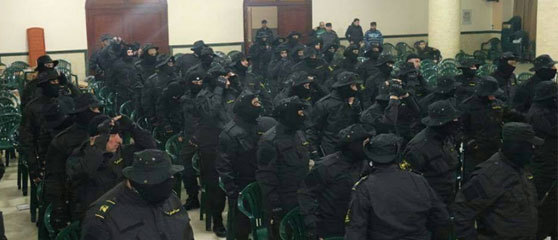
While the state response to drug-related violence was already defined as militarised, President Daniel Noboa – elected in November 2023 – has doubled down on this strategy, emulating El Salvador’s brutal crackdown on organised crime. On 8 January 2024, Noboa imposed a 60-day state of emergency, declaring a war on gangs and labelling them as terrorists. This emergency legislation enabled the military to enter prisons where many criminal gangs operated out of, and a night-time curfew on Ecuadorian citizens. Emergency legislation has been repeatedly renewed in March and in May, keeping the military in control of state security and people’s movements under strict control.
For a while, this approach worked. Homicides dropped by 13% in 2024, although they were still high for the region: Ecuador’s homicide rate stood at 38.8 deaths per 100,000 people, compared to Mexico’s 19.3 per 100,000, or Brazil’s of 21. The Ecuadorian military successful capture or execution of key figures within the country’s leading gangs by the military helped disrupt drug markets, with large cocaine seizures also slowing down successful criminal exports.

The human cost
Average citizens were caught in the crossfire of this drug war. They were locked in curfews, unable to protest or organise without risking being seen as criminally complicit. Most crucially, though, there’s limited evidence that the state of emergency were keeping people safe from harm. While homicides had dropped, most murder occured between criminal groups, whereas civilians are subject to kidnapping for ransom and extortion. Both of these crimes had increased during Noboa’s states of emergency.
“These things are still very real problems that affect Ecuadorians,” Gavin Voss, a researcher at Insight Crime, an investigative outlet with a focus on Latin America, explained. “These types of crimes impact citizens’ security, and citizens’ perceptions of security. It creates internal displacement crises, creates migration crises.”
Noboa’s war on drugs and crime has been criticised by human rights watchdogs due to repeated violations. This includes reports of excessive use of force by the military, with evidence of extrajudicial killings and arbitrary arrests.
Many human rights abuses have occurred in prisons, primarily because of their importance to criminal activities. According to InsightCrime, some of the key players of Ecuador’s drug markets operate from within the prison system. These groups, known as “prison mafias”, coordinate criminal actions both within and outside prisons.
“Everything kind of flows through the prisons. Orders from the top flow through the prisons before going from the bottom,” as Voss said.
As a result, the military’s actions within prisons have been brutal: stories from inside prisons even reveal instances of guards electrocuting prisoners. Meanwhile, interviewed military officials controlling prisons claimed: “At no point have any human rights been violated. There is no mistreatment”.
Ecuador has also published plans to build mega prisons to expand Ecuador’s carceral capacity, following the footsteps of the CECOT prison in El Salvador, which can house over 40,000 prisoners with no right to visitations, recreation or education. The nature of these mega prisons, built to be flooded with potential gang members, also sees a lack of due process and subsequent wrongful imprisonment, an issue already present in Ecuador.
What is the situation now?
Noboa’s war on gangs has deeply changed Ecuador’s criminal landscape.
“There’s been a lot of arrests of leaders, a lot of murders of leaders in gang conflict, and this has really thrown the underworld into a state of severe flux,” Voss said. As a result, he continued, “one of the things that has defined the last year and a half is fragmentation. Gangs are breaking apart. They’re fighting within each other, and that’s really pushing up the violence.”
This fragmentation has caused a spike in killings since the beginning of 2025, negating the efforts of the previous year. For example, in January alone, 781 people were murdered, making it one of the deadliest months in recent years.
With the collapse of Ecuador’s former powerful gangs – the Choneros, Lobos, and Tiguerones – after state-led actions, the subsequent power vacuum has caused clashes between many local gangs. Speaking to France24, one gang member said, “The war is over territory. There aren’t known leaders like before. Everyone wants their independence.”
Corruption within the government, police and military is a key issue that has also not been addressed in a systematic manner. And while officer Ramírez is facing a trial for his involvement with criminal organisations, it’s likely that many more members of the military and police are working with organised crime. Noboa’s administration has yet to implement a widespread policy or programme to deal with corruption; he himself was accused of facilitating drug trafficking through his family’s export businesses, which he admitted had happened in the past. Nonetheless, his administration is more intent on exacting violent justice on gangs and guilty individuals, as opposed to structural corruption. A critique of Noboa’s entire government is a lack of direction and the lack of a cohesive plan to deal with the organised crime in Ecuador. The lack of strong action on corruption perfectly illustrates this.
Noboa’s 2025 presidential election win
Over a year on from Ecuador’s January 2024 public crisis, the situation has arguably worsened for average civilians, with no end to violence in sight. Earlier this month, Noboa won re-election, securing another four year term with around 56% of the popular vote. Despite the violence of his previous government, he seems to still be widely supported across the nation; his campaign was boosted by his presidential powers, which he used to distribute cash payments for disaster victims and use national broadcasting services to promote his run.
Despite recommendations from human rights groups to explore alternative methods – like focusing on protecting prosecutors, dealing with corruption, and reinstating drug regulations – Noboa is likely to stay on his current path. In fact, as part of his election promises, he called for Trump to designate Ecuadorian gangs as terrorists, to build foreign military bases in the country, and for American and European troops to reinforce Ecuador’s fight against crime.
The current state of Ecuador, with emergency legislation governing the country, with frequent military activities exercising deadly violence, is likely to be the new normal. As with other Latin American nations in the past, more lives and communities are set to be torn apart in the ever-escalating violent drug war.