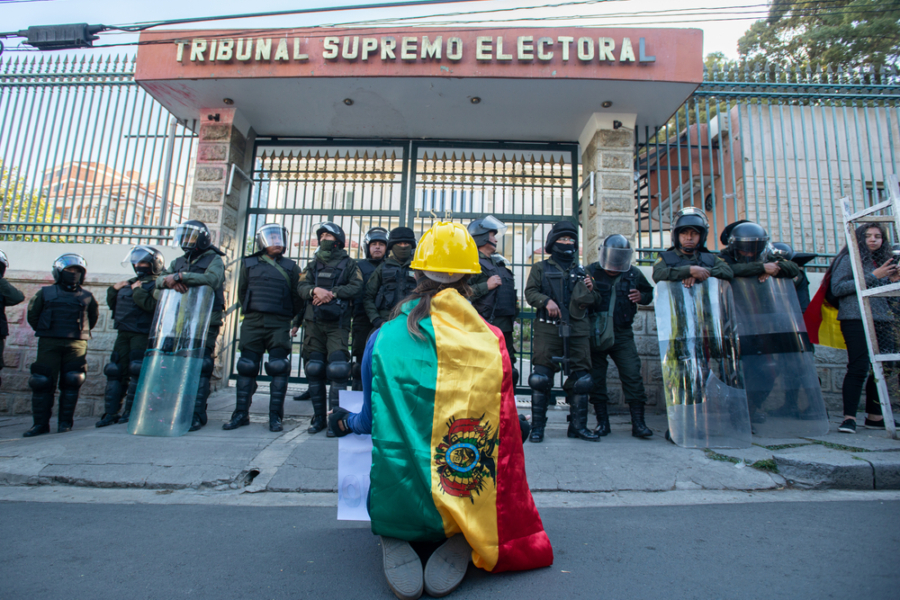
On 8 June, riot police fired tear gas through the streets of La Paz as protesters hurled stones and firecrackers back at them. Miners wielding dynamite clashed with officers outside the presidential palace. Bolivians were protesting an economic crisis, their worst in living memory. The government responded with borrowed rhetoric, eventually declaring a national emergency on 20 June.
At the beginning of June, with 103 road blockades paralysing seven departments and at least 10 people dead, President Rodrigo Paz stood before his generals and signed a law clearing the path for a state of emergency. As he did, he reached for a phrase to demonise the protestors, one he’d never used during his seven months in office.
“Our security is put at risk when narco-terrorism, and the priorities of certain actors, are not aligned with our democracy, our Constitution,” Paz said. “This law is to protect the majority of the country from the narco-terrorism that is instigating the protests.”
For Gloria Achá, program coordinator with Programa Libertas, a Bolivian civil society organisation working on drug policy reform, the label was instantly recognisable.
“Rodrigo Paz had not previously used the term narco-terrorism,” she told TalkingDrugs. “He is using it now, for the first time, to sustain his thesis that the social mobilisations are not a consequence of his own responsibility, but rather a creation of Evo Morales and the drug traffickers. The facts do not bear this out.”
Borrowed bluster
Since the beginning of his government, President Paz has taken measures to increasingly align the country with American regional ambitions. In February 2026, the DEA returned to Bolivia after a 17-year absence. In March, Bolivia joined Trump’s Shield of the Americas coalition as a founding member, and when Bolivian forces captured Sebastián Marset, the most wanted trafficker in the southern cone, they handed him directly to American custody. American Secretary of State Marco Rubio went so far as to call Paz’s election a “transformative opportunity.”
When protests erupted in Bolivia, Washington supported its new ally. US Defence Secretary Pete Hegseth declared his backing for Paz, warning of “narco-terrorist interference.” The Shield of the Americas issued a joint statement accusing unnamed forces of attempting to “undermine the constitutional order.” Days later, Paz signed his emergency powers law with the same borrowed vocabulary.
“Narco terrorists,” Paz now calls them, were putting “their own interests above those of Bolivian society,” despite presenting no evidence linking the blockades and marches to drug trafficking.
Rodrigo Paz repeats Donald Trump’s rhetoric,” Achá says. “Using the term narco-terrorism has neither operational nor technical utility in fighting drug trafficking. It is simply a narrative promoted by Trump to justify the involvement of the military in repression.”
On 18 June, two days before declaring a national emergency, Paz signed a US$20 million deal with the US to train and equip Bolivian forces to “fight drug trafficking.”
At the barricades
The narco-terrorism frame is not only cynical, but it also has direct consequences for people who use drugs. Around three months ago, following a series of contract killings over a single weekend in Santa Cruz, police deployed alongside the military for several days of street checkpoints across the city.
“Predictably, these patrols found no hitmen or drug traffickers,” Achá said. “But they did, in the course of these controls, arrest individuals carrying small quantities of substances for personal use.”
This is not to say that there aren’t legitimate concerns within Bolivia about the harms caused by criminal networks. Achá was quick to point out that drug trafficking violence in Bolivia has increased sharply in recent years, with contract killings a near-constant feature of life in parts of the country.
The problem has deepened under governments under left and right-wing governments alike, she said. “In Bolivia, there is extensive corruption within the police and across all state institutions, which means drug traffickers operate without difficulty regardless of which president is in power.” According to Achá, “The Bolivian state has already undergone capture by criminal organisations that operate under state protection.”
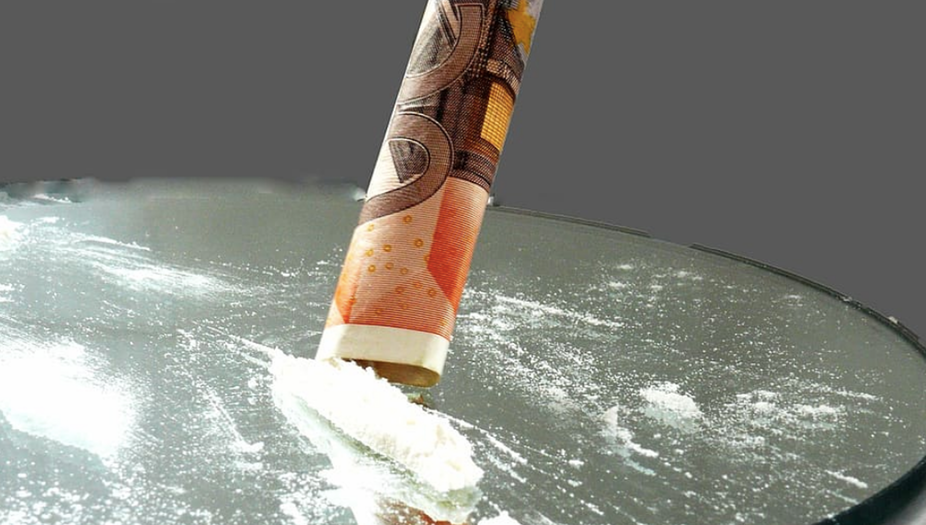
Bolivia is the world’s third-largest cocaine producer, and its own vice-minister for social defence recently claimed the overwhelming majority of Chapare coca is now diverted into the cocaine trade. It is thus a genuine concern about violence that has made many Bolivians willing to support the return of the DEA and greater US intervention. But, according to Achá, labelling striking teachers and marching miners as narco-terrorists achieves nothing.
“If the authoritarian approach advances and instruments of repression are reinforced, there will be greater obstacles to introducing reforms and a rights-based approach,” Achá warned.
Rejected reform
The crisis has arrived at a particularly bitter moment for Bolivian drug policy. Since 2013, Bolivia has been the exception for global drug prohibition: they were the first country to exit the UN international drug control conventions and re-sign them with a special exemption for coca chewing. This “community control” model allows for farmers to cultivate a small, monitored amount of coca leaf for traditional use, governed by their own unions. The system replaced a period of brutal DEA-backed crackdowns that produced chronic conflict, poverty, and human rights abuses in the region, with no lasting reduction in cocaine supply.
In 2023, Bolivia, alongside Colombia, initiated a review of coca’s Schedule I classification under the 1961 UN drug conventions. This effort was challenged by the US, who saw the control over cocaine’s key ingredient as crucial to its global prohibition. At the UN Commission on Narcotic Drugs thematic discussion in October 2025, the US delegation argued that removing coca from Schedule I would “derail our joint efforts and only reward the narcoterrorists.”
After two years, the World Health Organization’s Expert Committee on Drug Dependence – responsible for evaluating drug scheduling – determined in December 2025 that coca should remain a Schedule I substance. Experts and indigenous communities condemned the decision as a failure to recognise traditional use and to protect indigenous rights.
Bolivia and Donroe
Bolivia’s wrestling with the so-called Donroe Doctrine of American military interference in drug-related operations is not an isolated struggle. In Ecuador, US troops participated in joint ground operations for counter-narcotics purposes. John Walsh of the Washington Office on Latin America (WOLA) described the logic plainly: “For the administration, the narco-terrorism narrative provides an enabling narrative to justify a military hard power position in the Americas. You are going to do what we say, or suffer the consequences.”
While in Latin America, those most vocally opposed to the Donroe Doctrine are Colombia and Mexico, smaller states like Bolivia are more economically vulnerable to American influence. Though Colombia and Bolivia collaborated on the attempted UN coca reform, President Paz expelled Bolivia’s Colombian ambassador at the height of the unrest, after the now former Colombian President Petro expressed support for the protestors.
Paz’s government approved the use of military force against Bolivian protestors and declared a state of emergency. It now says there are no more roadblocks, cleared by the Bolivian army. The process to legitimise this violence has been achieved, in part, by the application of the narcoterrorist label borrowed from the US. It is unclear where, when, and how this chapter of Bolivia’s history will end.
Achá was not hopeful about her country’s prospects: “There will be clashes and many deaths.” She said, “The underlying problems will remain. The future outlook is not good.”