“I will meet u at the station with the stuff when u arrive. No worries mate. I’ll be on tuk-tuk ;)”
Stepping out of the station and straight into the city square, its immense double-towered Gothic cathedral looming, my man was waiting on his bike: a shadow sitting as straight as the spires above.
I got his number from a Telegram channel. GBP £10 in exchange for three dial-a-dealers in the western German city where I was spending four days with friends. He had the best English, so he got the okay.
He waved at me with a grin — perhaps recognising the British millennial male tourist in me — and beckoned me onto the back. We raced ten minutes through wide commercial avenues and backstreets. En route, I purchased some drugs.
I was thinking: if I don’t get robbed, this is insanely smooth – the gap between consumer and plug closing, access to illicit substances becoming ever more seamless.
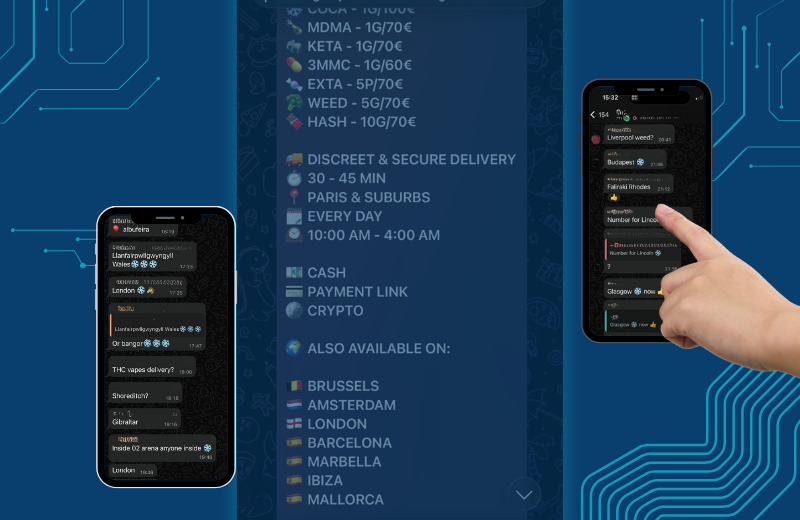
There are now a slew of dial-a-dealer sourcing groups on WhatsApp and Telegram, many operating without a fee. From Swansea to Sydney, just pop in your location, and often, especially if you’re in an urban environment, you’ll tap into a local dealer network selling everything from Class A stimulants to ketamine, tusi, weed, shrooms or black market benzos. A quick “hi mate, you around?” and you’re flying.
I’ve thought about them a lot over the last couple of years: about their effect on drug culture, whether they encourage impulsive or compulsive buying. Or, perhaps, they’re a natural adaptation, offering a bit more transparency in an industry that’s always had to work in the shadows.
Access is too easy
For some, that plug and play access is the problem.
“If I was still in the world of using drugs, these groups would be a nightmare. It’s just constant access – I wouldn’t be able to say no,” says Jo Barber, founder of The Other Side Of The Fear, who used Telegram groups while living in Berlin. Of these, she says that the access was sometimes instant, even meeting people in clubs. “You could post that you were in Berghain: ten minutes later you’d be meeting someone to pick up by the toilets.”
Ciaran — who mostly uses them to buy cocaine and MDMA while on holiday across Europe — disagrees. “They’re better than getting random drugs off the street as they can be screened [vetted] to an extent.” He says that “it’s a mixed bag in terms of quality” but that “standard seemed better in Europe than anything I’ve got in the UK”.
Ciaran mentions the names of different sourcing groups, spread across WhatsApp and Telegram. I’m on several (for research purposes). If you’re active on drugs Telegram, rave regularly or think 8am is a logical time to buy drugs – you’ll know them.
How it works
Broadly, they fall into three different models: some are free, moderated groups where people post their location, with any number-swapping occurring in DMs.
Some are paid and membership-based communities, where transcontinental drug experts roam, bantering each other off. Requests are fulfilled mainly by the group founders or people employed by them.
Then there’s a free-to-use Telegram bot, joined by a private sign-up link. It’s now pretty ubiquitous: a Yellow Pages of international contacts whose details are often shared across a constellation of online groups and communities.
But are they any good? As a man of increasing vintage, my nights with drugs are sparse and meticulously charted these days, with random, unplanned calls to men of Balkan heritage a rare occurrence.
But there have been two occasions I strayed from this approach in recent years – when I was deep into pints and, crucially, nowhere near the right frame of mind to be taking drugs, chasing oblivion when what I needed was calm. The groups offered the perfect escape hatch and I contacted new untrusted sources, paying below market rate, which is a wildly red flag.
Neither time finished particularly late, but I was then kept up all night unable to sleep, twitching on adulterated cocaine bash that I would not, in the right frame of mind, purchase.
The second instance, in particular, last summer, led to me flying completely off the handle. I experienced suicidal thoughts and, though my partner – and eventually some sleep around 1pm – calmed me down, it was dreadful. A dark midday of the soul.
This was the crescendo of a long, difficult period and while some will counter that the problem was “me”, there’s a nascent body of work around the effect of cocaethylene (a unique byproduct of cocaine and alcohol) on suicidality – particularly in men.
I put it mostly down to sleeplessness, combined with the depressive effects of the drink on an already depressed brain, more than the coke itself. I’ve had numerous times of not being able to sleep after drugs, and it’s generally fine once you’ve accepted things and switch on Friends instead. But would I have sunk so low without the access provided by those groups?
Research has found that the conditions of our immediate environment play a huge role in drug-seeking behaviour – a variation of the “people, places and things” that Alcoholics Anonymous preaches that its members must avoid to keep their sober stretches going.
Dopamine gets released just from talking about cocaine with people you normally do bumps with – let alone entering the pub on a Friday night where you’ve got a favourite toilet stall. But whereas we used to have barriers for drug use – your dealer went to bed; you’re on holiday and don’t know anyone – modern technology ensures those barriers are being eroded. Especially in cities.
At the risk of going all “old man shouts at clouds”, one of the nice things about going on holiday in the past was taking a break from the accoutrements shaping our lives at home. Now, as we take our phones with us everywhere, we also transport our penchant for a gram of coke or ket after four pints of fizzy lager.
Light and shade
But it’s not all doom and gloom. These apps do put a form of power back in the hands of consumers, democratising access and stopping thirsty people trying to score off randos on the Ramblas or in the Red Light District.
I was in Amsterdam last week and – despite somewhat successful efforts to disrupt the street trade – you can easily spot the roadmen lurking among the beaming windows of the De Wallen area.
But on a previous visit, I got a number from a group and – after being sent the most lavish menu, a real 10-course taster affair covering every possible narcotic proclivity – an amenable young guy met me outside my hotel.
He came up to my room, chatting breezily like he was bringing up some scrambled eggs. I bought a few bits: each of stellar quality and reasonable value with the ketamine (which I don’t especially like) being the best I’d ever done.
Between the darkweb and the streets
For me, these sourcing communities sit somewhere between the darkweb – which is self-governed and has a feedback loop that broadly ensures a higher grade of customer service – and your local dealer. Some of them even have ratings, with users leaving comments, discussing a particular contact in a group, or enabling “trusted vendor” statuses.
Research into darkweb markets backs this up. A 2025 paper analysing the Polish language darknet market Cebulka found that “while most users focus on efficient transactions and security, a smaller, committed minority fosters a sense of shared purpose and community.”
These groups can have a fair bit of “sesh” posturing, but they’re also hubs where members share harm reduction info in a way that’s relatable to them – unlike the more career psychonautical leanings of Reddit, Erowid or Bluelight. I’ve seen the top hierarchical figures within groups – who carry weight – tell people when they’re getting lost in the sauce; anything that broadly demystifies drug use is good.
“You always have a personal choice – to go home – rather than carry on taking drugs,” says Jo Barber. “But are these groups perpetuating a problem for people that can’t stop?”
Ciaran takes a slightly different tack, suggesting that he “doesn’t think these groups promote random seshes. If someone wants drugs, they will find it either way.”
After picking up from that tuk-tuk, I marvelled at the wonder of our smoothly interconnected world and the tenacity of modern app developers and drug networks – dropping this wrap into my lap before I’d even checked in.
But then that horrible morning last August, I cursed them. Still, they’re not going anywhere. And the easier they are to access, the harder it is to pretend that prohibition can keep up.
This article has been republished and edited with David’s consent from his Substack, WHAT ARE YOU ON. You can follow WHAT ARE YOU ON on Instagram.